🏔 Kilimanjaro Guide15 min readUpdated November 2026
Plan your climb with confidence
All Kilimanjaro Routes — Which Is Right for You?
Seven established approaches lead to one extraordinary summit. Compare the landscapes, durations, difficulty and acclimatisation profiles to choose the Kilimanjaro route that best matches your time, experience and climbing priorities.
Choosing a route is about much more than selecting a trail on a map. It shapes how quickly you gain altitude, how many nights you spend acclimatising, the landscapes you encounter, where you sleep and how much time you have to adjust to the mountain.
Two climbers with similar fitness can have very different experiences depending on their itinerary. A route with a more gradual ascent and sufficient time for acclimatisation may be a better choice than a shorter, cheaper itinerary that gains height quickly. The right route should balance your available days, budget, previous trekking experience and willingness to camp or stay in mountain huts.
🏔 The most important planning principleWhenever your schedule and budget allow, consider an itinerary with more time on the mountain. Additional days can support acclimatisation, provide recovery time and make the overall trek less rushed. More days do not guarantee a summit, but a carefully designed itinerary is an important part of responsible preparation.
⚠️ A note about the “easiest route”Marangu is sometimes promoted as the easiest option because it has hut accommodation and a more gradual trail in places. However, its shorter itineraries can leave limited time for acclimatisation. Hut accommodation does not automatically make a route easier or safer at altitude. Compare the number of days and the full elevation profile before deciding.
A quick route finder
Find the Kilimanjaro Route That Suits You
Answer these two questions to see a starting recommendation. Use it as a planning guide rather than a medical or mountaineering assessment.
1. How many days can you allow for the climb?
2. What matters most to you?
The quiz uses your stated time and preference to suggest a route to explore. It does not evaluate fitness, medical suitability or your personal likelihood of reaching the summit.
Compare before you choose
All Seven Kilimanjaro Routes at a Glance
Use this overview to compare the typical duration, estimated success-rate figures supplied for this guide, difficulty, route character and indicative starting prices. Actual itineraries and outcomes vary between operators and climbers.
*Success-rate figures and starting prices above are the indicative figures requested for this page, based on the supplied competitor reference. They are not independently verified GoAccessAfrica performance statistics or a guarantee of an individual climber’s outcome. Prices are subject to itinerary, inclusions, group size and travel date.
Understand the mountain
Acclimatisation: Why More Time Can Make a Difference
As you climb higher, the available oxygen pressure decreases. Your body needs time to adjust. A route should therefore be assessed by its full elevation profile and sleeping altitudes—not simply by the number of kilometres or the highest point reached during the day.
Some itineraries include a “climb high, sleep low” pattern: hikers reach a higher point during the day before descending to sleep at a lower camp. This can help the body adapt, although it does not remove the risk of altitude illness. The pace, rest, hydration, health and individual response also matter.
Route / itinerary
Typical time above 3,000m
High point before summit
Summit approach
Planning consideration
Lemosho 8-day
Several nights
Lava Tower area, approx. 4,600m
Barafu area to Uhuru Peak
Longer western approach and varied acclimatisation profile
Northern Circuit 9-day
Several nights
Upper northern camps, itinerary-dependent
School Hut / upper camp to Uhuru Peak
Long itinerary with gradual circumnavigation
Machame 7-day
Several nights
Lava Tower area, approx. 4,600m
Barafu area to Uhuru Peak
Includes a high point followed by a lower sleeping camp
Rongai 7-day
Several nights
Kikelewa / Mawenzi area, itinerary-dependent
Kibo Hut to Uhuru Peak
Northern approach with a more gradual trail in sections
Shira 8-day
Several nights
Shira Plateau / Lava Tower area
Barafu area to Uhuru Peak
Starts high; previous altitude exposure is an important consideration
Marangu 6-day
Fewer nights than longer routes
Kibo Hut, approx. 4,700m
Kibo Hut to Uhuru Peak
Hut-based itinerary; compare the shorter and longer versions carefully
Shira route: understand the high starting pointThe Shira approach reaches the high plateau by vehicle, so trekkers can begin the walking itinerary at a substantially higher elevation than on routes that start in the forest. This may be challenging for people who have not recently been at altitude. Discuss your recent altitude exposure and the planned first-day elevation with your operator before choosing it.
Camp sequences and elevations can vary by operator and itinerary. Confirm the exact day-by-day route plan before booking.
Explore every approach
Route-by-Route Kilimanjaro Profiles
Each route offers a different combination of terrain, atmosphere, accommodation and daily effort. Read the profiles to understand what the route feels like—not just how many days it takes.
Best overall route profile
Lemosho Route
A scenic western approach with a rewarding gradual build-up
From / person$2,050
Duration7–8 days
Success rate*~91%
DifficultyModerate–hard
AtmosphereQuieter start
Lemosho begins on the western side of Kilimanjaro and is known for its forest approach, open moorland and wide views across the Shira Plateau. As the trek progresses, the route joins the southern circuit and passes landmark terrain such as Lava Tower and the Barranco Wall before moving towards the summit camps. The longer itinerary gives trekkers more time on the mountain than many shorter options.
It is often shortlisted by climbers who want a varied landscape and a longer schedule. The early western section is generally less busy than some of the main southern approaches, although the route becomes shared with other trails higher on the mountain.
✓ Advantages
Beautiful and varied western landscapes
Longer itinerary options for acclimatisation
Quieter opening days compared with busier approaches
Includes the Southern Circuit highlights
Good choice for trekkers wanting a fuller mountain journey
! Considerations
Usually costs more than shorter itineraries
Requires more days away from home
Camping throughout the route
Upper sections are shared with other routes
Western access involves a longer transfer
Best suited to: First-time Kilimanjaro trekkers who have enough time, scenery lovers, photographers and climbers prioritising a longer itinerary.
The well-known “Whiskey Route” through dramatic southern scenery
From / person$1,750
Duration6–7 days
Success rate*~85%
DifficultyChallenging
AtmospherePopular
Machame approaches from the south-west and climbs through rainforest, moorland and high alpine terrain. Its route profile includes the Lava Tower area and the descent towards Barranco Camp, followed by the well-known Barranco Wall. The route later crosses the southern slopes before the summit attempt.
The 7-day version generally allows more time than the 6-day itinerary. Machame is a camping route and includes some steep, uneven sections, so trekkers should be prepared for consecutive days of walking and changing weather conditions.
✓ Advantages
Varied and striking landscapes
Recognisable Barranco Wall section
Climb-high, sleep-low opportunities on the itinerary
Well-established route with broad operator experience
Two duration options commonly offered
! Considerations
Can be busy during peak climbing periods
Steeper sections require sure footing
Camping rather than hut accommodation
Six-day itinerary is more compressed
Some days involve long trekking hours
Best suited to: Trekkers who enjoy a physically active itinerary, want varied scenery and can allow around seven days for the climb.
A quieter ascent from the northern side near the Kenyan border
From / person$1,950
Duration6–7 days
Success rate*~83%
DifficultyModerate
AtmosphereQuiet
Rongai is the principal route approaching Kilimanjaro from the north. The northern side is generally drier than the southern slopes, and the trail often feels more remote during the early days. The landscape is more open in places, with broad views towards the Kenyan plains and the mountain’s northern faces.
Many itineraries descend via the Marangu side, giving trekkers a different perspective on the mountain on the way down. The 7-day option offers more time than the shorter version and is worth comparing when acclimatisation is a priority.
✓ Advantages
Often quieter on the lower mountain
Northern approach with a distinct landscape
Generally drier conditions on the north side
Descent commonly uses a different route
Gradual trail sections in the early stages
! Considerations
Some trekkers find the scenery less varied early on
Transfer to the northern trailhead takes time
Camping accommodation
Summit night remains physically demanding
Shorter itinerary leaves less time to adjust
Best suited to: Climbers who prefer a quieter approach, those interested in the northern side of Kilimanjaro and trekkers looking for a different ascent-and-descent experience.
The historic “Coca-Cola Route” and Kilimanjaro’s hut-based option
From / person$1,650
Duration5–6 days
Success rate*~72%
DifficultyModerate
AccommodationMountain huts
Marangu is one of the mountain’s oldest and best-known routes. It approaches from the south-east and is the only standard Kilimanjaro route with dormitory-style hut accommodation along the trail. Trekkers sleep in shared huts rather than tents, which can appeal to people who prefer a fixed shelter.
The ascent and descent use the same general route, so the scenery is less varied than on routes that traverse different sides of the mountain. The shorter 5-day itinerary is particularly compressed; climbers should compare it carefully with the 6-day option and discuss the acclimatisation profile with their operator.
✓ Advantages
Hut accommodation instead of camping tents
Established trail and facilities
Often a lower starting price
More gradual trail sections in places
Useful option for trekkers who strongly prefer huts
! Considerations
Same general route for ascent and descent
Huts are shared and can be busy
Shorter itinerary offers limited adjustment time
Hut beds do not remove altitude risks
Less landscape variety than traverse routes
Best suited to: Trekkers who prefer hut accommodation and understand the importance of choosing a suitable duration. Compare the 6-day itinerary rather than choosing on price alone.
A direct, steep approach intended for experienced mountain trekkers
From / person$1,800
Duration6–7 days
Success rate*~68%
DifficultyVery hard
AtmosphereRemote
Umbwe is a steep and direct southern approach. Its early trail climbs through forest and ridge terrain before joining the Southern Circuit near the Barranco area. The rapid gain in elevation and demanding gradient make it a route that deserves careful consideration rather than being selected simply because it is less crowded.
For many climbers, a route with a more gradual ascent and additional acclimatisation time will be a more appropriate choice. Anyone considering Umbwe should be honest about previous trekking experience, physical preparation and the ability to manage sustained steep terrain at altitude.
✓ Advantages
Remote feel on the lower approach
Steep ridge and forest scenery
Joins the scenic Southern Circuit
Appeals to experienced trekkers seeking a demanding route
! Considerations
Steep and physically demanding early stages
Rapid altitude gain requires careful assessment
Not the first choice for most first-time climbers
Camping throughout the trek
Low indicative success-rate figure in this comparison
Best suited to: Experienced trekkers with prior mountain experience who understand the route’s steep profile and have discussed its suitability with a qualified operator.
A long traverse around the quieter northern slopes
From / person$2,800
Duration9–10 days
Success rate*~95%
DifficultyModerate–hard
AtmosphereRemote
The Northern Circuit is the longest commonly used Kilimanjaro route. After approaching from the west and crossing the Shira Plateau, it travels around the northern side of the mountain before turning towards the summit. The extended itinerary offers more days on the mountain and a chance to experience quieter, wide-open landscapes away from the busiest southern trails.
It is a substantial time and budget commitment. The longer duration can provide more opportunities for acclimatisation, but no route guarantees a summit and the final ascent remains physically demanding. Check the exact itinerary, camping arrangements and support plan before booking.
✓ Advantages
Longest standard itinerary among the main routes
Extended time for acclimatisation
Remote northern landscapes and quieter trail sections
Broad range of mountain scenery
Near-circumnavigation creates a complete journey
! Considerations
Higher overall price and longer holiday required
Remote sections need careful logistics
Camping throughout the route
Weather exposure over a longer trek
Not necessary for every climber’s schedule or budget
Best suited to: Trekkers with 9 or more days available who value a longer, quieter route and want to experience more of Kilimanjaro’s northern slopes.
A western approach that begins on the high Shira Plateau
PriceContact us
Duration7–8 days
Success rate*~82%
DifficultyModerate–hard
LandscapeOpen plateau
Shira approaches Kilimanjaro from the west and shares much of its upper mountain terrain with Lemosho. One important difference is the high starting point: the route commonly uses vehicle access to reach the Shira Plateau, meaning trekkers begin walking at a much higher elevation than on routes that start in the rainforest.
This high start is a key factor to discuss before choosing Shira. People who have not recently spent time at altitude may find the initial elevation challenging. Lemosho’s lower starting approach is often preferred by trekkers seeking a more gradual introduction to the mountain, while Shira may appeal to those whose itinerary and previous altitude exposure make the high start appropriate.
✓ Advantages
Wide-open Shira Plateau scenery
Western approach and access to the Southern Circuit
Shares upper mountain highlights with Lemosho
Distinctive high-altitude landscape early in the trek
! Considerations
High starting elevation needs careful consideration
Less gradual first walking day than lower-start routes
Camping throughout the trek
Not ideal for everyone without recent altitude exposure
Confirm the exact vehicle drop-off elevation and schedule
Best suited to: Trekkers whose previous altitude exposure, schedule and operator assessment make a high plateau start suitable. Compare it closely with Lemosho before deciding.
There is no single route that is best for every climber. The right choice depends on the time you can commit, the type of scenery you want, your previous experience at altitude, your accommodation preference and your budget.
Your priority
Routes worth comparing
Why consider them?
Longer itinerary and varied scenery
Lemosho 8-day / Northern Circuit
More time on the mountain and varied landscapes.
Popular route with dramatic terrain
Machame 7-day
Well-known southern approach with notable landscape features.
Quieter northern approach
Rongai 7-day
Different mountain perspective and generally quieter lower trail.
Hut accommodation
Marangu 6-day
The standard route with dormitory hut facilities.
Extended remote experience
Northern Circuit
Long traverse around the northern side.
Steep, demanding route
Umbwe
Only after carefully considering prior mountain experience.
High plateau western scenery
Shira / Lemosho
Compare the high Shira start with Lemosho’s lower approach.
Our advice before you bookDo not choose by headline price or a success-rate percentage alone. Ask for the full day-by-day itinerary, sleeping elevations, number of nights above 3,000 metres, what is included in the price, group size, guide-to-climber arrangements and the operator’s emergency procedures. A responsible operator should welcome these questions.
Need help choosing your route?
Share your available days, trekking experience and priorities. Our team can help you compare the options.
Which Kilimanjaro route is best for first-time climbers?
Many first-time climbers compare the longer Lemosho, Machame and Northern Circuit itineraries because they offer more days on the mountain than the shortest options. The best choice depends on your available time, health, preparation and the exact itinerary.
Which Kilimanjaro route is the quietest?
Rongai and the northern sections of the Northern Circuit are often chosen by trekkers looking for a quieter experience. Crowd levels still vary by season and departure date.
Which route has hut accommodation?
Marangu is the standard Kilimanjaro route with dormitory-style mountain huts. Most other routes use camping accommodation.
How many days should I spend climbing Kilimanjaro?
There is no universal number that suits everyone. Longer itineraries generally provide more time for gradual ascent and acclimatisation. Compare the full sleeping-altitude profile rather than duration alone.
Is the Umbwe Route suitable for beginners?
Umbwe is a steep and demanding approach. It is generally not the first option to recommend to a first-time high-altitude trekker. Discuss your previous mountain experience and the route profile with a qualified operator.
Are the success rates guaranteed?
No. Success rates are historical or estimated figures and can vary depending on the operator, route duration, group, season and how outcomes are recorded. They cannot predict an individual climber’s result.
Can I combine Kilimanjaro with a Tanzania safari?
Yes. Many travellers arrange a wildlife safari before or after their climb. Allow adequate recovery time and discuss the best sequence with your tour operator.
Mountain trekking involves physical exertion, changing weather and altitude-related risks. This guide is general trip-planning information, not medical advice. Seek appropriate medical advice before attempting a high-altitude climb, and follow your mountain guide’s safety instructions.
Keep planning your Tanzania adventure
More Kilimanjaro Guides
Explore more practical information to prepare for your climb and plan the rest of your Tanzania journey.
Kilimanjaro Guide
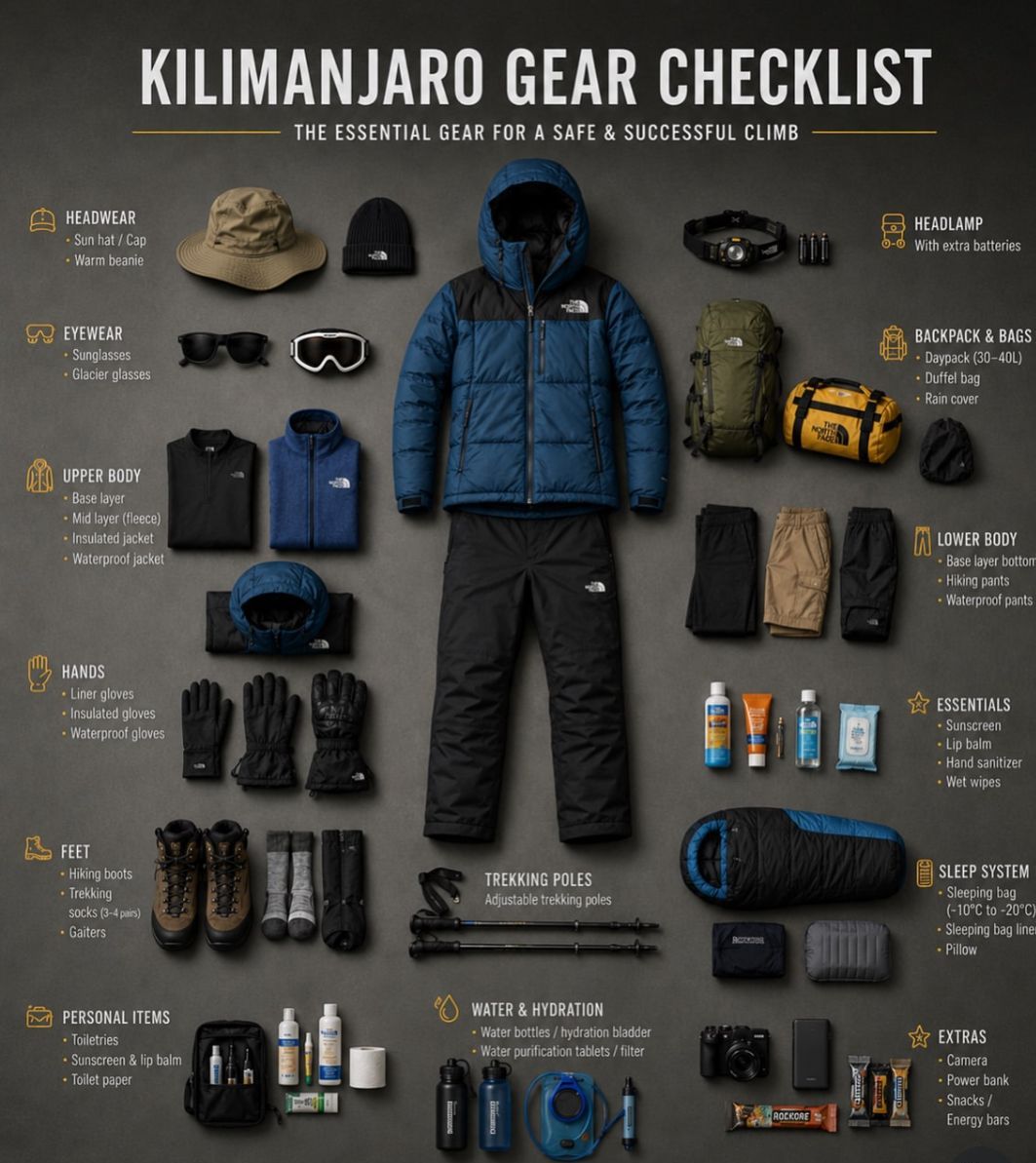
Kilimanjaro Gear List
Prepare your clothing, footwear, sleeping equipment and essential trekking accessories.